


25 U.S. Virgin Islands Reef Fish Every Snorkeler Should Know

Discover the Fish You'll See While Snorkeling in the USVI

Whether you're snorkeling in St. John, exploring the reefs around St. Thomas, or diving in St. Croix, you'll be surrounded by an incredible variety of U.S. Virgin Islands reef fish. This guide features the 25 species most commonly encountered during NOAA's 2025 National Coral Reef Monitoring Program (NCRMP) surveys.
From colorful parrotfish and wrasses to curious puffers and graceful butterflyfish, these are the U.S. Virgin Islands reef fish you're most likely to spot on your next snorkeling adventure.
Whether you're a first-time snorkeler or an experienced underwater photographer, learning to recognize these common Caribbean reef fish will make every snorkel even more rewarding.
How This Guide Is Organized
Each fish profile includes:
📸 Photo
📋 Quick Facts
🔍 How to Identify It
🪸 Reef Role
📍 Where You'll Find It
💡 Fun Fact
🐠 Snorkeler's Tip: Many Caribbean reef fish change color throughout their lives. Juveniles can look completely different from adults – especially wrasses and parrotfish – so don't be surprised if two fish that look unrelated are actually the same species.
Jump to a Fish
The 25 Most Common Reef Fish in the U.S. Virgin Islands
These aren't necessarily the biggest or most colorful fish on the reef, but they are the species you're most likely to encounter while snorkeling throughout the U.S. Virgin Islands. If you can recognize these 25 fish, you'll be able to identify a large percentage of the reef life you see during your visit.
Bluehead Wrasse

Quick Facts
Scientific Name: Thalassoma bifasciatum
Family: Wrasse (Labridae)
Max Length: 6 in (15 cm)
Often Confused With: Rainbow Wrasse and Clown Wrasse
How to Identify
Adult males have a brilliant blue head and vibrant green body, while females and juveniles are mostly yellow with a dark stripe running along their sides. They're constantly on the move, darting around the reef in search of food.
Reef Role
Bluehead Wrasses feed on small crustaceans, worms, and parasites, helping keep reef ecosystems healthy and balanced.
Where You'll Find It
Bluehead Wrasses are the most commonly encountered reef fish in the U.S. Virgin Islands. They're especially abundant on shallow coral reefs, patch reefs, and around coral heads, where they spend the day actively searching for food.
Fun Fact
Most Bluehead Wrasses begin life as females, but some later change into males. If the dominant male disappears, the largest female may take his place.
Redband Parrotfish

Quick Facts
Scientific Name: Sparisoma aurofrenatum
Family: Parrotfish (Scaridae)
Max Length: 11 in (28cm)
Often Confused With: Redtail Parrotfish, Stoplight Parrotfish
How to Identify
The Redband Parrotfish has a beak-like mouth used for scraping algae from coral and rocks. Terminal-phase adults are typically reddish-brown to olive-green with a distinctive red or orange band just behind the mouth. Females and juveniles have different colors and markings but share the same blunt, parrot-like beak.
Reef Role
Redband Parrotfish are important algae grazers, helping prevent algae from overgrowing corals and supporting a healthy reef ecosystem.
Where You'll Find It
You'll usually find Redband Parrotfish grazing algae on shallow coral reefs, patch reefs, and rocky areas.
Fun Fact
Parrotfish don't have individual teeth like most fish. Instead, hundreds of tiny teeth are fused together into a powerful beak that's perfect for scraping algae from hard surfaces. Every bite helps keep the reef healthy – and over time, some of the ground-up coral they ingest is excreted as the soft white sand found on Caribbean beaches.
Ocean Surgeonfish

Quick Facts
Scientific Name: Acanthurus tractus
Family: Surgeonfish (Acanthuridae)
Max Length: 14 in (35 cm)
Often Confused With: Doctorfish, Blue Tang
How to Identify
The Ocean Surgeonfish has a gray to olive-brown body with subtle blue highlights and a white patch at the base of the tail containing a sharp, scalpel-like spine. Unlike the Blue Tang or Doctorfish, it lacks bold colors or stripes, giving it a more understated appearance.
Reef Role
Ocean Surgeonfish spend much of the day grazing algae from rocks and coral.
Where You'll Find It
Ocean Surgeonfish are most often found on shallow coral reefs, patch reefs, and rocky shorelines, where they graze alongside Blue Tangs and Doctorfish.
Fun Fact
The "surgeon" in their name comes from the razor-sharp spine on each side of the tail. This hidden "scalpel" is used for defense and can deliver a surprisingly painful slash if the fish feels threatened.
Blue Tang

Quick Facts
Scientific Name: Acanthurus coeruleus
Family: Surgeonfish (Acanthuridae)
Max Length: 15 in (38 cm)
Often Confused With: Ocean Surgeonfish, Doctorfish
How to Identify
Adult Blue Tangs are a brilliant royal blue with an oval-shaped body. Juveniles are bright yellow and gradually change to blue as they mature. Like all surgeonfish, they have a sharp, scalpel-like spine at the base of the tail for defense.
Reef Role
Blue Tangs spend much of the day grazing algae from coral and rocks, supporting healthy coral growth.
Where You'll Find It
Blue Tangs are often seen on shallow coral reefs and patch reefs, grazing alone, in small groups, or alongside other surgeonfish in schools numbering into the hundreds!
Fun Fact
Blue Tangs don't start out blue! Juveniles are bright yellow before gradually transforming into the vivid blue adults that make them one of the Caribbean's most recognizable reef fish.
Yellowhead Wrasse

Quick Facts
Scientific Name: Halichoeres garnoti
Family: Wrasse (Labridae)
Max Length: 12 in (30 cm)
Often Confused With: Yellowcheek Wrasse
How to Identify
Terminal-phase males are easy to recognize by their bright yellow head and blue-green body. Initial-phase adults have an orange-tan body with two wavy blue lines behind the eye, while juveniles are bright yellow orange with a vivid blue stripe running from the eye to the tail. No matter the life stage, they're slender, active swimmers that rarely stay still.
Reef Role
Yellowhead Wrasses feed on small invertebrates hidden among the coral, keeping reef communities in balance.
Where You'll Find It
Look for Yellowhead Wrasses weaving through coral heads and rocky reefs as they search for small invertebrates.
Fun Fact
Don't blink! Yellowhead Wrasses are among the busiest fish on the reef, constantly darting from coral to coral in search of their next meal – making them a favorite sight for snorkelers but a challenge for underwater photographers.
Bicolor Damselfish

Quick Facts
Scientific Name: Stegastes partitus
Family: Damselfish (Pomacentridae)
Max Length: 4 in (10 cm)
Often Confused With: Cocoa Damselfish, Dusky Damselfish
How to Identify
The Bicolor Damselfish is easy to recognize by its two-toned body – a dark charcoal to black front half and a bright white to pale yellow rear half. Small but bold, these fish are often seen hovering just above coral heads before quickly darting back to cover.
Reef Role
Bicolor Damselfish feed on algae, plankton, and tiny invertebrates, helping transfer energy through the reef food web while serving as prey for larger reef fish.
Where You'll Find It
Bicolor Damselfish stay close to coral heads and rocky crevices, rarely venturing far from their chosen shelter.
Fun Fact
Don't let their size fool you! Bicolor Damselfish are fiercely territorial and will boldly chase away fish many times their size if they get too close to their home.
Striped Parrotfish

Quick Facts
Scientific Name: Scarus iseri
Family: Parrotfish (Scaridae)
Max Length: 11 in (27 cm)
Often Confused With: Princess Parrotfish, Queen Parrotfish
How to Identify
Juveniles and initial-phase adults have two horizontal white stripes running the length of the body. Terminal-phase males have wavy pink stripes on the tail and develop brighter blue-green and pink colors. Their beak-like mouth is another giveaway.
Reef Role
Striped Parrotfish spend much of the day scraping algae from rocks and dead coral, helping prevent algae from overgrowing living corals and supporting a healthy reef ecosystem.
Where You'll Find It
Striped Parrotfish are often seen grazing along shallow reefs, patch reefs, and the edges of seagrass beds.
Fun Fact
At night, Striped Parrotfish wrap themselves in a thin mucus cocoon before going to sleep. Scientists believe this slimy sleeping bag may help hide their scent from nighttime predators and parasites.
Slippery Dick

Quick Facts
Scientific Name: Halichoeres bivittatus
Family: Wrasse (Ladridae)
Max Length: 9 in (22 cm)
Often Confused With: Blackear Wrasse, Bluelip Parrotfish
How to Identify
Juveniles are white-tan with one dark stripe running the length of the body, while adults vary from green to pink with a pink line radiating from the eye. Like many wrasses, they have a slender body and are constantly on the move as they search the reef for food.
Reef Role
Slippery Dicks feed on small invertebrates hiding among rocks and coral, helping keep reef ecosystems balanced by controlling populations of tiny reef animals.
Where You'll Find It
Slippery Dicks prefer shallow habitats, especially seagrass beds, but are also found around coral rubble and nearby reefs. Their constant movement makes them easy to spot – but hard to photograph.
Fun Fact
Yes, that's really its name! The Slippery Dick gets its unusual name from its slick, slippery scales and its incredible ability to dart away before predators – or curious snorkelers – can get too close.
Stoplight Parrotfish

Quick Facts
Scientific Name: Sparisoma viride
Family: Parrotfish (Scaridae)
Max Length: 25 in (64 cm)
Often Confused With: Redband Parrotfish, Redtail Parrotfish
How to Identify
Terminal-phase males are bright blue-green with a distinctive yellow spot at the base of the tail – the "stoplight." Initial-phase adults look completely different, with a reddish-brown body and a bright red belly. Together, the two life phases show the classic stoplight colors: red, yellow, and green.
Reef Role
Stoplight Parrotfish are important algae grazers that help keep coral reefs healthy by preventing algae from dominating the reef.
Where You'll Find It
Stoplight Parrotfish are frequently seen grazing on shallow coral reefs, patch reefs, and reef slopes throughout the U.S. Virgin Islands. They spend much of the day scraping algae from rocks and coral.
Fun Fact
If you hear a crunching sound underwater, it might be a parrotfish at work! Stoplight Parrotfish use their powerful beaks to scrape algae from rocks and coral, often making an audible crunch with every bite.
Yellowtail Snapper

Quick Facts
Scientific Name: Ocyurus chrysurus
Family: Snapper (Lutjanidae)
Max Length: 34 in (86 cm)
Often Confused With: Schoolmaster Snapper, Yellow Goatfish
How to Identify
Yellowtail Snappers have a slender, silvery body with a bright yellow stripe running from the snout to the deeply forked yellow tail. Unlike many reef fish, they're often seen swimming in the open water just above the reef, either alone or in loose schools.
Reef Role
Yellowtail Snappers are opportunistic predators, feeding on small fish and invertebrates. They help keep populations of smaller reef animals in balance and are an important link in the coral reef food web.
Where You'll Find It
Yellowtail Snappers are usually found hovering above coral reefs and reef drop-offs, often cruising in loose schools over the reef.
Fun Fact
Unlike many reef fish that spend most of their time close to the coral, Yellowtail Snappers often gather in loose schools above the reef.
Foureye Butterflyfish
Quick Facts
Scientific Name: Chaetodon capistratus
Family: Butterflyfish (Chaetodontidae)
Max Length: 6 in (15 cm)
Often Confused With: Spotfin Butterflyfish, Reef Butterflyfish
How to Identify
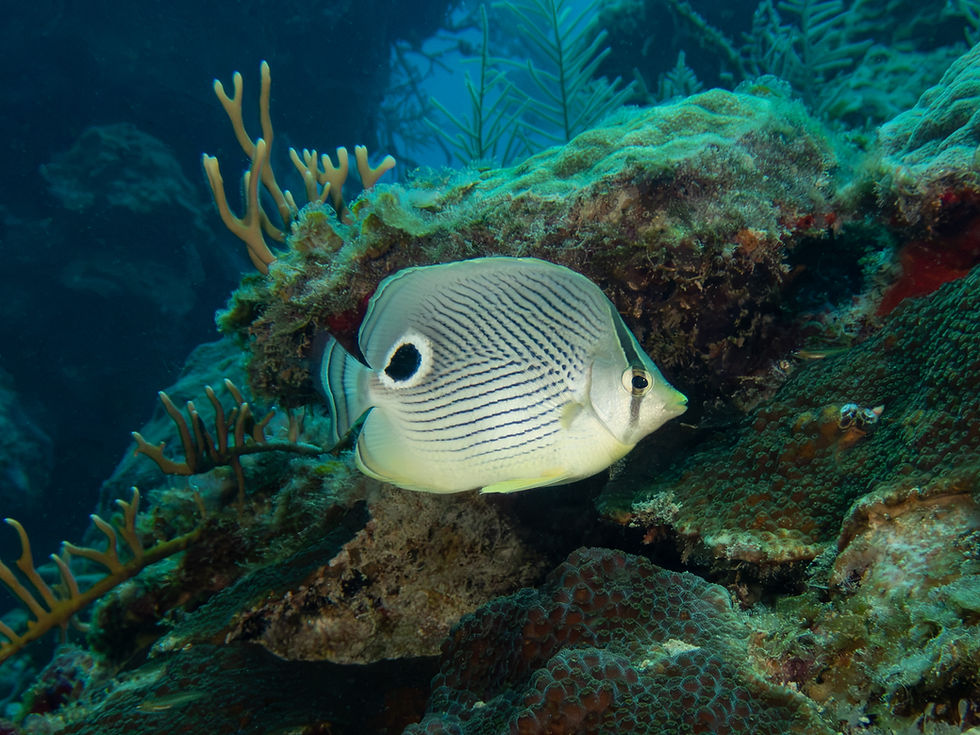
The Foureye Butterflyfish has a light yellow body covered with fine, dark chevron-shaped lines, a dark bar through the eye, and a large black eyespot outlined in white near the base of the tail. It's most often seen swimming in pairs around coral reefs.
Reef Role
Foureye Butterflyfish feed on coral polyps and tiny invertebrates found among the reef. Unlike algae-grazing fish, they help regulate populations of the small animals living on and around corals.
Where You'll Find It
Foureye Butterflyfish are common around coral heads, patch reefs, rocky shorelines, and shallow reefs throughout the U.S. Virgin Islands. They're often seen swimming in pairs as they carefully pick food from the reef.
Fun Fact
The Foureye Butterflyfish gets its name from the false eye near its tail. Combined with the black stripe hiding its real eye, this clever disguise can confuse predators about which end is the head, giving the fish a split second to escape.
French Grunt

Quick Facts
Scientific Name: Haemulon flavolineatum
Family: Grunt (Haemulidae)
Max Length: 12 in (30 cm)
Often Confused With: Bluestriped Grunt, White Grunt
How to Identify
French Grunts have a silvery body covered with numerous thick, bright yellow stripes. The stripes run mostly straight along the upper body but become slightly angled across the middle and lower body. Their fins are bright yellow, and they’re often seen gathered in schools.
Reef Role
French Grunts feed on small invertebrates, helping keep populations of worms and crustaceans in balance. They also serve as an important food source for larger reef predators.
Where You'll Find It
Look for schools of French Grunts beneath reef ledges, overhangs, around coral heads, and near shipwrecks. During the day they gather in the shade before venturing out to feed at night.
Fun Fact
French Grunts get their name from the grunting sound they make by grinding their throat teeth together and amplifying the noise with their swim bladder. Scientists believe these sounds help them communicate and stay together in schools.
Bar Jack

Quick Facts
Scientific Name: Caranx ruber
Family: Jack (Carangidae)
Max Length: 28 in (79 cm)
Often Confused With: Yellow Jack, Blue Runner
How to Identify
Look for the bright electric-blue stripe that begins at the snout, runs along the top of the back, and continues along the lower edge of the lower tail lobe. A bold black stripe borders the blue stripe above, creating a striking pattern unique among Caribbean jacks. The body is sleek and silvery with a crescent-shaped (lunate) tail and long, sickle-shaped pectoral fins built for speed.
Reef Role
Bar Jacks are fast, opportunistic predators that feed on small fish, shrimp, squid, and other invertebrates. As active hunters, they help regulate populations of smaller reef animals and are an important link in the reef food web.
Where You'll Find It
You'll usually spot Bar Jacks cruising above coral reefs, along reef edges, and over seagrass beds. They're often seen swimming alone or in small groups, especially in clear, shallow water.
Fun Fact
Juvenile Bar Jacks are known to shadow sea turtles, stingrays, and even large fish, staying close to their larger companions. Scientists believe this behavior provides protection from predators and may also help the young jacks catch prey that gets stirred up as the larger animal moves.
Longspine Squirrelfish

Quick Facts
Scientific Name: Holocentrus rufus
Family: Squirrelfish (Holocentridae)
Max Length: 17 in (44 cm)
Often Confused With: Squirrelfish, Glasseye Snapper
How to Identify
Longspine Squirrelfish have a bright red body, very large eyes, and a deeply forked tail. Their long dorsal spines are marked with a row of white triangular blotches behind each spine tip, making them easy to identify. Their oversized eyes are an adaptation for seeing in low-light conditions.
Reef Role
Longspine Squirrelfish emerge at night to feed on shrimp, crabs, worms, and other small invertebrates. As nocturnal predators, they help keep populations of these animals in balance while serving as prey for larger reef predators.
Where You'll Find It
During the day, Longspine Squirrelfish tuck beneath ledges, inside caves, or under coral overhangs. At night, they leave their hiding places to forage over the reef.
Fun Fact
The brilliant red color that makes Longspine Squirrelfish so striking is almost invisible underwater in low light. Red is the first color to disappear as sunlight fades with depth, helping these fish blend into the reef at dawn, dusk, and night despite their vivid appearance.
Sharpnose Pufferfish

Quick Facts
Scientific Name: Canthigaster rostrata
Family: Pufferfish (Tetraodontidae)
Max Length: 5 inches (12 cm)
How to Identify
Look for a small puffer with a pointed snout, a brown back fading to yellowish below, and delicate blue markings around the eyes and snout. Blue spots cover much of the body, while the yellow tail is boldly outlined in black with a white patch at its base.
Reef Role
Sharpnose Puffers feed on algae, sponges, tunicates, small crustaceans, and other tiny invertebrates. By grazing on a variety of reef organisms, they help maintain a healthy balance within the reef ecosystem.
Where You'll Find It
Sharpnose Puffers hover close to coral heads, rocky reefs, and seagrass beds. They're curious fish and often pause to inspect snorkelers before darting away to the next crevice.
Fun Fact
Despite their tiny size, Sharpnose Puffers can inflate their bodies by gulping water when threatened, making themselves much harder for predators to swallow. Like many pufferfish, they also contain toxins that discourage predators from taking a bite.
Blue Chromis

Quick Facts
Scientific Name: Azurina cyanea
Family: Damselfish (Pomacentridae)
Max Length: 6 in (15 cm)
Often Confused With: Blue Tang
How to Identify
Blue Chromis are brilliant electric blue with a deeply forked tail. A thin black line runs along the upper back, while black edging highlights the upper and lower margins of the tail. Their streamlined bodies shimmer as they swim above coral heads.
Reef Role
Blue Chromis feed primarily on plankton drifting in the water column. By transferring energy from tiny plankton to larger reef predators, they play an important role in the reef food web.
Where You'll Find It
Blue Chromis typically hover just above coral heads and patch reefs. They spend much of the day feeding on plankton in open water before quickly retreating into the reef for shelter when danger approaches.
Fun Fact
Unlike many reef fish that graze on the bottom, Blue Chromis spend most of their time feeding in the water column. That's why you'll often see them "floating" above the reef rather than swimming close to the coral.
Doctorfish

Quick Facts
Scientific Name: Acanthurus chirurgus
Family: Surgeonfish (Acanthuridae)
Max Length: 13 in (34 cm)
Often Confused With: Ocean Surgeonfish, Blue Tang
How to Identify
Doctorfish have a grayish-brown body with 8–12 narrow dark vertical bars. Remember: a doctor who commits malpractice ends up "behind bars." Look for the pale band across the base of the tail to confirm your identification.
Reef Role
Doctorfish are herbivores that graze on algae growing over rocks and coral, helping prevent algae from overwhelming the reef and leaving space for corals to thrive.
Where You'll Find It
Doctorfish graze on algae among coral reefs and are often seen in mixed schools with Blue Tangs and Ocean Surgeonfish, sometimes numbering in the hundreds.
Fun Fact
Watching a school of Surgeonfish feed is like watching a choreographed dance. Hundreds of fish cruise together until, as if someone rang a dinner bell, they all stop to graze before suddenly moving on in unison to the next patch of algae.
Spotted Goatfish

Quick Facts
Scientific Name: Pseudupeneus maculatus
Family: Goatfish (Mullidae)
Max Length: 12 in (30 cm)
Often Confused With: Yellow Goatfish
How to Identify
Spotted Goatfish have a whitish to pink body with three large reddish-black spots along the back beneath the dorsal fins. Like all goatfish, they have a pair of whisker-like barbels beneath the chin.
Reef Role
Spotted Goatfish use their sensitive chin barbels to search the sand for worms, crustaceans, and other small invertebrates. As they dig, they stir up the seafloor, helping recycle nutrients and creating feeding opportunities for other reef animals.
Where You'll Find It
Spotted Goatfish are found around shallow coral reefs, sandy bottoms, and nearby seagrass beds.
Fun Fact
Those "whiskers" aren't for decoration – they're packed with sensory organs. Spotted Goatfish use their barbels like underwater metal detectors, sweeping the sand to locate buried prey they can't even see.
Princess Parrotfish

Quick Facts
Scientific Name: Scarus taeniopterus
Family: Parrotfish (Scaridae)
Max Length: 12 in (30 cm)
Often Confused With: Striped Parrotfish, Queen Parrotfish
How to Identify
Terminal-phase Princess Parrotfish are bright blue with pink bars on each scale. Look for the short yellow stripe above the pectoral fin and green stripes running through and above the eye.
Reef Role
Princess Parrotfish graze on algae growing over rocks and coral, helping keep reefs healthy by preventing algae from overgrowing corals.
Where You'll Find It
Princess Parrotfish frequently seen cruising over coral reefs, where they spend much of the day grazing and exploring the reef.
Fun Fact
Their colorful scales shimmer differently as they turn, making them appear to change color even while swimming.
Harlequin Bass

Quick Facts
Scientific Name: Serranus tigrinus
Family: Sea Basses & Groupers (Serranidae)
Max Length: 5 in (12 cm)
Often Confused With: Lantern bass
How to Identify
Harlequin Seabass have a white upper body that fades to yellowish below, crossed by bold black bars. Their dorsal and tail fins are decorated with rows of black spots, giving them a striking, hand-painted appearance.
Reef Role
Harlequin Seabass are ambush predators that feed on small fish, shrimp, and other tiny crustaceans. They help keep populations of small reef animals in balance.
Where You'll Find It
Harlequin Seabass rest near sandy patches, coral rubble, rocky outcrops, and seagrass beds around shallow reefs. They often stay close to cover, darting into a crevice or beneath a rock when threatened.
Fun Fact
Despite their bold pattern, Harlequin Seabass are surprisingly easy to overlook. Their black bars and spotted fins help break up their outline, providing excellent camouflage among seagrass, coral rubble, and shadows on the reef.
Cocoa Damselfish

Quick Facts
Scientific Name: Stegastes xanthurus
Family: Damselfish (Pomacentridae)
Max Length: 5 in (12 cm)
Often Confused With: Beaugregory Damselfish, Threespot Damselfish, Longfin Damselfish
How to Identify
Adult Cocoa Damselfish have an oval grayish-brown body with a yellowish belly. The dark edges of each scale form diagonal lines across the body, giving them a subtle crosshatched pattern. Juveniles look completely different, with brilliant yellow bodies highlighted by electric-blue markings.
Reef Role
Cocoa Damselfish are territorial algae farmers. They cultivate and defend small patches of algae, providing a steady food supply while creating tiny habitats that support other reef organisms.
Where You'll Find It
Cocoa Damselfish stay close to their favorite coral head or rocky crevice. They'll often dart out to chase away fish that wander into their territory.
Fun Fact
Cocoa Damselfish are some of the reef's hardest-working gardeners. They carefully tend small "algae gardens," weeding out less desirable algae and aggressively defending their crop from hungry intruders.
Graysby
Quick Facts
Scientific Name: Cephalopholis cruentata
Family: Sea Basses & Groupers (Serranidae)
Max Length: 13 in (33 cm)
Often Confused With: Coney, Red Hind
How to Identify
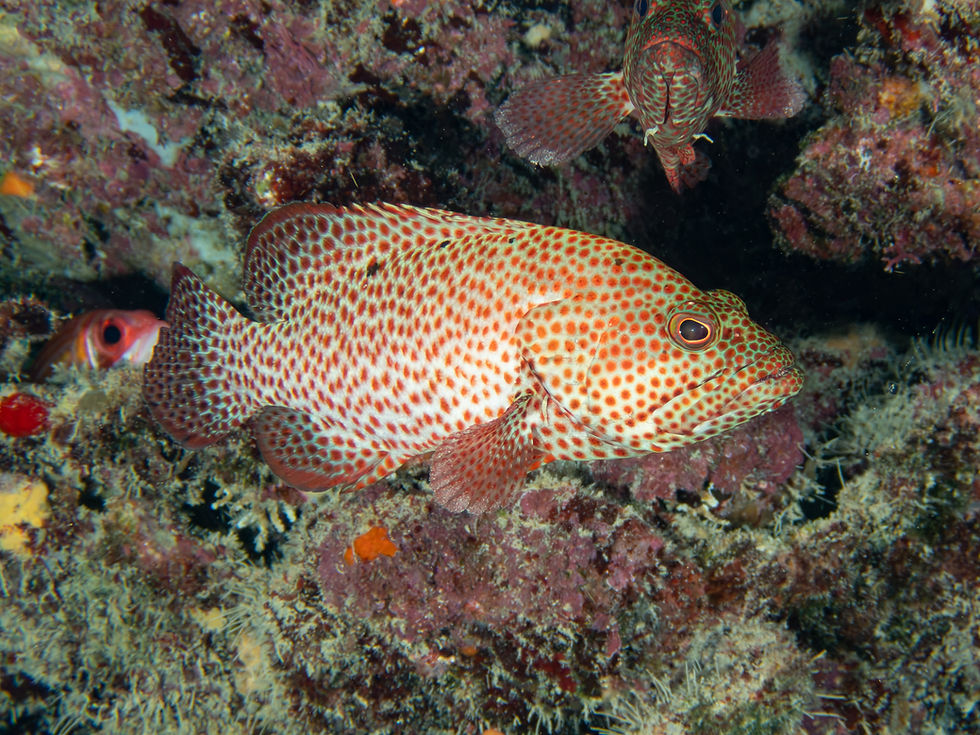
Graysby are gray, brown, or olive with small orange-brown spots covering the head, body, and fins. Look for the four spots along the upper back, which can change from black to white. I remember them as four "bullet holes" that have grazed the fish's back.
Reef Role
Graysby are ambush predators that hide among coral and rocky ledges before darting out to catch small fish and crustaceans. They help keep populations of smaller reef animals in balance.
Where You'll Find It
Frequently seen around coral reefs, rocky ledges, and caves. They often hover beneath overhangs or peek out from crevices, watching nearby divers and snorkelers before slipping back into cover.
Fun Fact
Graysby are naturally curious. Instead of immediately swimming away, they'll often stop beneath a ledge and watch you just as closely as you're watching them.
Squirrelfish

Quick Facts
Scientific Name: Holocentrus adscensionis
Family: Squirrelfish (Holocentridae)
Max Length: 18 in (45 cm)
Often Confused With: Longspine Squirrelfish, Glasseye Snapper
How to Identify
Squirrelfish have a reddish-orange body, large eyes, and a bright yellow dorsal fin. Their large eyes are adapted for seeing in low light, and unlike the Longspine Squirrelfish, they lack the long, prominent dorsal spines and white triangular markings behind them.
Reef Role
Squirrelfish feed mainly on shrimp, crabs, and other small crustaceans. They hunt after dark, filling the role of a nighttime predator on the reef.
Where You'll Find It
You'll usually spot Squirrelfish hiding in reef crevices, caves, and beneath ledges during the day. After sunset, they emerge to forage across the reef.
Fun Fact
Despite their quiet appearance, Squirrelfish are surprisingly vocal. They communicate with low grunts made by vibrating muscles attached to their swim bladder.
Clown Wrasse

Quick Facts
Scientific Name: Halichoeres maculipinna
Family: Wrasses (Labridae)
Max Length: 6 in (15 cm)
Often Confused With: Slippery Dick, Blackear Wrasse
How to Identify
Juvenile Clown Wrasse have a yellow stripe above a black stripe running from snout to tail, with the first hints of their signature "clown makeup" beginning to appear on the face. Initial-phase fish have a dark green back, a lighter belly, pink-edged scales, and three bold red facial bars. Terminal-phase fish are similar but brighter overall and develop a distinctive dark blotch on the middle of the body.
Reef Role
Clown Wrasse feed on small crustaceans, worms, and other tiny invertebrates hiding among the reef and sandy bottom, helping keep these populations in balance.
Where You'll Find It
Clown Wrasse are usually spotted around coral reefs and nearby sandy areas, where they constantly weave through the reef in search of small prey.
Fun Fact
Like many wrasses in the genus Halichoeres, Clown Wrasse are believed to spend the night buried beneath the sand, emerging after sunrise to resume searching the reef for food.
Queen Triggerfish

Quick Facts
Scientific Name: Balistes vetula
Family: Triggerfish (Balistidae)
Max Length: 25 in (65 cm)
Often Confused With: Ocean Triggerfish (less colorful)
How to Identify
Queen Triggerfish are easy to recognize by their bright colors and distinctive facial markings. Look for the yellow cheek crossed by two diagonal blue stripes, along with blue-edged dorsal, anal, and tail fins. Their small, beak-like mouth is built for crushing hard-shelled prey.
Reef Role
Queen Triggerfish feed on sea urchins, crabs, mollusks, and other hard-shelled invertebrates. Their powerful teeth help keep populations of these animals in balance while recycling nutrients on the reef.
Where You'll Find It
Look for Queen Triggerfish cruising over coral reefs, rocky bottoms, and sandy areas.
Fun Fact
Triggerfish get their name from a clever locking mechanism in their first dorsal spine. When raised, the spine locks into place like a trigger, making it difficult for predators to pull the fish from a crevice. To lower it, the fish presses a second, smaller spine – releasing the "trigger."
Tips for Spotting Reef Fish While Snorkeling
Want to see more fish on your next snorkel? Slow down and let the reef come to you. Many reef fish are naturally curious and will often swim closer if you remain calm and still.
A few simple tips can dramatically improve what you see:
Move slowly and avoid sudden movements.
Stay horizontal in the water to reduce splashing.
Look around coral heads and beneath rocky ledges where many fish hide.
Pause frequently – fish often emerge once you stop swimming.
Never chase, touch, or feed marine life.
Give turtles, rays, and other wildlife plenty of space.
The more relaxed you are, the more the reef comes alive.
Why Reef Fish Are Important
Every reef fish has an important role to play in keeping Caribbean coral reefs healthy.
Herbivores like parrotfish and surgeonfish spend their days grazing algae from rocks and coral. Without them, algae can quickly overgrow reefs, making it harder for corals to survive.
Predatory fish help keep smaller fish and invertebrate populations balanced, while species like wrasses feed on tiny crustaceans, worms, and parasites that could otherwise become too abundant. Even small schooling fish help transfer energy through the food web by serving as food for larger predators.
Healthy reefs depend on healthy fish populations. The incredible diversity you'll see while snorkeling isn't just beautiful – it's a sign that the ecosystem is functioning as nature intended.
Every fish, from the smallest damselfish to the largest triggerfish, plays a part in keeping the reef alive.
Best Places to See Reef Fish in the U.S. Virgin Islands
One of the best things about snorkeling in the U.S. Virgin Islands is that you don't have to go far to find amazing marine life. Healthy coral reefs throughout St. John, St. Thomas, and St. Croix are home to hundreds of reef fish species.
Some of the best places to encounter the fish in this guide include:
Waterlemon Cay and Leinster Bay
Little St. James
Lovango Cay
Pelican Rock
Offshore patch reefs around St. John and St. Thomas
While many excellent snorkeling spots can be reached from shore, a private boat gives you access to quieter reefs with fewer crowds, clearer water, and even more opportunities to observe marine life.
Reef Fish Checklist
Turn your next snorkel into a scavenger hunt! Save this list to your phone – or print it before your trip – and see how many of these 25 common Caribbean reef fish you can identify during your visit to the U.S. Virgin Islands.
☐ Bluehead Wrasse
☐ Redband Parrotfish
☐ Ocean Surgeonfish
☐ Blue Tang
☐ Yellowhead Wrasse
☐ Bicolor Damselfish
☐ Striped Parrotfish
☐ Slippery Dick
☐ Stoplight Parrotfish
☐ Yellowtail Snapper
☐ Foureye Butterflyfish
☐ French Grunt
☐ Bar Jack
☐ Longspine Squirrelfish
☐ Sharpnose Pufferfish
☐ Blue Chromis
☐ Doctorfish
☐ Spotted Goatfish
☐ Princess Parrotfish
☐ Harlequin Bass
☐ Cocoa Damselfish
☐ Graysby
☐ Squirrelfish
☐ Clown Wrasse
☐ Queen Triggerfish
Frequently Asked Questions
What are the most common reef fish in the U.S. Virgin Islands?
This guide is based on NOAA's 2025 National Coral Reef Monitoring Program surveys in the U.S. Virgin Islands. Species like the Bluehead Wrasse, Redband Parrotfish, Ocean Surgeonfish, Blue Tang, and Yellowhead Wrasse are among the most frequently encountered reef fish throughout the U.S. Virgin Islands.
Are Caribbean reef fish dangerous?
Almost all reef fish are harmless to snorkelers. While a few species have defensive spines or sharp teeth, they are not aggressive toward people. The best approach is simple: admire marine life from a respectful distance and never attempt to touch or feed wild animals.
Why are there so many parrotfish?
Parrotfish spend most of the day grazing algae from rocks and coral. Because they help prevent algae from overgrowing coral reefs, healthy populations of parrotfish are one of the best indicators of a thriving reef ecosystem.
What's the difference between a Blue Tang and a Doctorfish?
Both belong to the surgeonfish family, making them easy to confuse at first glance.
Adult Blue Tangs are a vibrant royal blue, while Doctorfish are grayish-tan with 8–12 narrow dark bars running down their sides.
Easy way to remember: A doctor who commits malpractice could end up behind bars – and the Doctorfish has bars!
What is the easiest reef fish to identify?
Blue Tangs, Bluehead Wrasses, Yellowtail Snappers, Queen Triggerfish, and Foureye Butterflyfish are among the easiest Caribbean reef fish to recognize thanks to their distinctive colors and markings.
Will I see all 25 fish on one snorkel?
Probably not – but that's part of the fun! The species you encounter depend on where you snorkel, the time of day, water conditions, and a little luck. Even experienced snorkelers discover something new every time they enter the water.
Explore the Reefs of the U.S. Virgin Islands
Now that you know what to look for, it's time to put your fish identification skills to the test.
Bring an underwater camera, move at the reef's pace, and keep this guide handy – you might be surprised how many of these 25 common reef fish you can identify before your snorkel is over.
Want to become even better at identifying reef fish? Check out my six-part Caribbean Fish Identification series, where you'll learn how to tell similar-looking species apart, recognize juvenile and adult life phases, and uncover even more fascinating facts about the reef's most colorful residents.
Ready to See These Fish for Yourself?
Reading about Caribbean reef fish is fun – but nothing compares to spotting them in the wild.
Join me aboard Beach Bum and explore the beautiful reefs around St. John and St. Thomas, where you'll have the chance to slow down, take in the underwater world, and discover many of the species featured in this guide.
While I stay aboard the boat during your snorkel, I'm always happy to help identify the fish you've seen, answer questions about the reef, and share fun facts about the marine life you encounter. I also keep laminated fish identification guides on board, so you can compare your sightings and see how many species you can check off your list.
Whether you're snorkeling for the first time or you've explored reefs around the world, every trip offers something new to discover.
Ready to start checking fish off your list? Book your private snorkeling charter today and see how many of these 25 common reef fish you can find!
📸 All photos courtesy of Sara Richter 📸


Comments